dSPACE delivers comprehensive solutions for ECU software development and validation, leveraging both Software-in-the‑Loop (SIL) and Hardware-in-the‑Loop (HIL) simulation across the full development lifecycle. These integrated platforms help automotive engineers accelerate testing, ensure quality, and transition seamlessly from virtual environments to real-time hardware testing.
SIL enables ECU software validation before the actual hardware exists. Virtual ECUs (V‑ECUs) encapsulate production-level code, including AUTOSAR components and generated application logic. These run on PC-based systems such as dSPACE VEOS, enabling early integration testing, automated regression flows, and scalable testing in the cloud.
Key advantages:
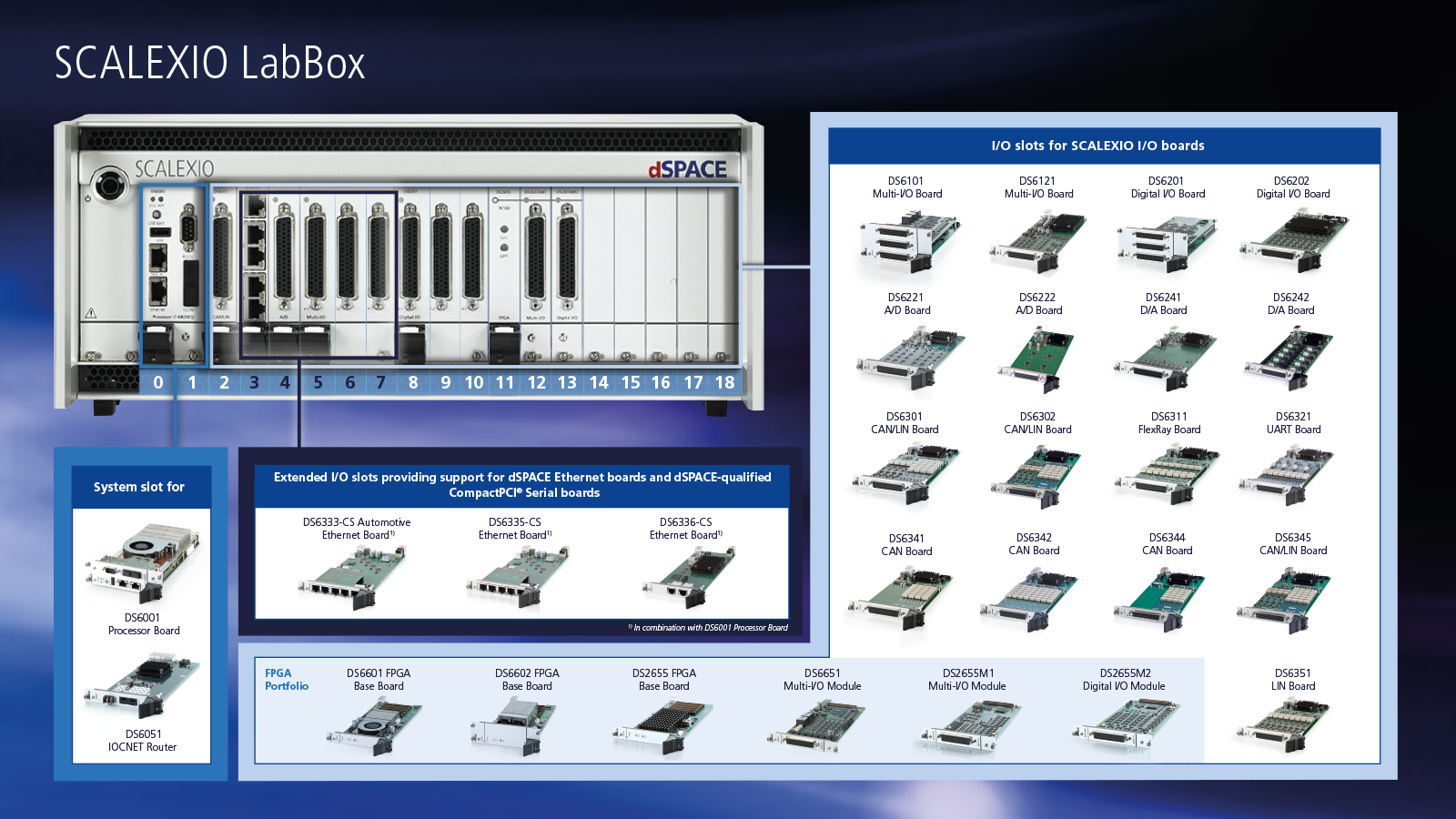
HIL testing connects real ECUs to real-time plant simulation environments, allowing direct interaction with virtual vehicle models. dSPACE’s SCALEXIO system provides modular, high-performance hardware to emulate vehicle dynamics, sensor inputs, and bus communications in closed-loop fashion.
Benefits include:
dSPACE ensures a seamless transition from SIL to HIL, enabling consistent use of models, test cases, and configurations across both environments. This unified workflow is key to accelerating ECU development cycles while maintaining test coverage and traceability.
Supporting tools include:
Soft ECUs or V‑ECUs created from Simulink/TargetLink or AUTOSAR models allow full functional testing without hardware. These can be reused in both PC-based SIL and real-time HIL systems.
A scalable software environment that executes V‑ECUs and plant simulations deterministically on desktop or cloud infrastructure, accelerating test coverage and enabling parallel execution.
Highly configurable real-time hardware paired with ConfigurationDesk allows seamless deployment of models from Simulink into real-time HIL, supporting extensive I/O and network emulation.
SYNECT manages test artifacts and variant dependencies, enabling efficient continuous integration. AutomationDesk supports GUI-based test authoring and test suite execution in SIL and HIL environments.
Early Validation & Development
Full ECU Validation & Testing
Continuous Integration & Regression Testing
| Capability | Benefit |
| Early SIL validation | Software errors identified before hardware exists |
| Closed-loop HIL testing | Safe, repeatable validation of ECU behavior under load |
| Automated test workflows | Fast regression, variant management, and CI support |
| Unified toolchain | Shared models, tests, and interfaces across SIL and HIL |
| Scalability | From desktop simulation to cloud to full real‑time racks |
With its integrated SIL and HIL solutions—including VEOS, SCALEXIO, SYNECT, and AutomationDesk—dSPACE empowers automotive developers to streamline ECU development, achieve higher test quality, and shorten time-to-market. By unifying virtual and hardware-based validation while supporting continuous integration and automation, dSPACE ensures rapid, safe, and reliable testing of complex vehicle controllers across domains from powertrain to autonomous driving.